
- Targeted fat metabolism support
- No impact on blood sugar or insulin
- Potential joint and cartilage support
- Excellent safety profile across clinical trials
I’ll be honest — when I first heard about AOD-9604, the pitch sounded almost too clean. A peptide that burns fat like growth hormone but without the blood sugar spikes, the IGF-1 concerns, or the jaw-widening side effects? Sign me up.
Then I dug into the research. And the story got a lot more complicated.
AOD-9604 has one of the most interesting trajectories in the peptide world: genuinely promising animal data, a safety profile that held up across six human clinical trials, and then… a pivotal Phase IIb trial that fell flat on its face. It’s the peptide equivalent of a movie with a great first act and a disappointing ending.
But that doesn’t mean the whole story is worthless. Let me walk you through what we actually know.
The Short Version: AOD-9604 is a 16-amino acid peptide derived from the fat-burning region of human growth hormone. It promotes fat breakdown without raising IGF-1 or disrupting blood sugar — a genuinely unique profile. The catch? Its largest human trial failed to produce significant weight loss. It’s well-tolerated and may offer modest body composition benefits for people already doing the hard work of diet and exercise, but it’s not a fat-loss shortcut.
What Is AOD-9604?
AOD-9604 — short for Anti-Obesity Drug 9604 — is a synthetic peptide developed in Australia at Monash University during the 1990s by Professor Frank Ng’s lab. The core insight behind it was elegant: human growth hormone has distinct regions responsible for different effects. The C-terminal end (amino acids 176-191) handles fat metabolism, while other regions drive growth, cell proliferation, and the blood sugar disruption that makes full HGH problematic.
So Ng’s team essentially snipped out the fat-burning fragment and added a single tyrosine amino acid to the end for stability. That’s AOD-9604 — growth hormone’s fat-loss module, isolated and stabilized.
The Australian biotech company Metabolic Pharmaceuticals ran it through six clinical trials involving over 900 participants between 2002 and 2006. Then in 2007, the whole program was shelved after the biggest trial failed to hit its endpoint. More on that shortly.
Today, AOD-9604 lives in a regulatory gray zone. It’s not FDA-approved for anything. WADA bans it for athletes. A GRAS (Generally Recognized As Safe) determination was issued in 2014, and the FDA’s Pharmacy Compounding Advisory Committee reviewed it again in December 2024. You’ll find it primarily through compounding pharmacies and research peptide suppliers.
How Does AOD-9604 Work?
Here’s the plain-English version: AOD-9604 tells your fat cells to release their stored energy and simultaneously tells them to stop storing new fat. It does this without touching the growth or blood-sugar machinery that makes full growth hormone risky.
Now the science. AOD-9604 works through at least two key mechanisms:
First, it upregulates beta-3 adrenergic receptors in fat tissue. These are the receptors that, when activated, signal fat cells to break down stored triglycerides into free fatty acids your body can burn. Research by Heffernan et al. showed that both full HGH and AOD-9604 restored suppressed beta-3 receptor levels in obese mice back to lean-mouse levels. Think of it as reactivating a switch that obesity had turned off.
Second, it stimulates lipolysis while inhibiting lipogenesis — promoting fat breakdown and blocking new fat creation simultaneously. Animal studies showed significant increases in fat oxidation and elevated plasma glycerol, which is a reliable marker that fat is actively being broken down.
Here’s what matters most for the safety-conscious: AOD-9604 does not bind to the growth hormone receptor. It doesn’t raise IGF-1. It doesn’t cause the glucose intolerance or insulin resistance that full HGH does. Across every study, it left blood sugar, insulin levels, and glucose oxidation completely untouched.
That selectivity is genuinely remarkable. It’s the whole reason this peptide exists.
Reality Check: Strong animal data doesn’t always translate to humans. AOD-9604 is a textbook example — the mice lost significant weight, but the largest human trial didn’t produce clinically meaningful fat loss. Keep that gap in mind as you evaluate this peptide.
There’s also emerging research on joint health. A 2015 animal study found that AOD-9604 promotes proteoglycan and collagen production in cartilage cells. When injected directly into joints alongside hyaluronic acid, it enhanced cartilage regeneration in rabbits with osteoarthritis. It’s a single animal study — far too early to draw conclusions — but it’s an interesting secondary angle.
Benefits of AOD-9604
Let me break this down honestly by evidence quality, because the picture is genuinely mixed.
What the Animal Data Shows (Strong)
Multiple studies consistently demonstrate that AOD-9604 reduces body weight gain by over 50% in obese mice, increases fat oxidation, and stimulates lipolysis over 14+ days of treatment. In rodent models, this peptide works. Clearly and repeatedly.
What the Human Trials Showed (Mixed)
The Phase IIa trial (12 weeks) was encouraging — subjects taking 1 mg/day oral AOD-9604 lost an average of 2.6 kg versus 0.8 kg on placebo. Modest, but real.
Then came the Phase IIb trial. 536 subjects. 24 weeks. Oral doses of 1, 5, 10, 20, and 30 mg. The result? No statistically significant difference from placebo at any dose. That’s a clear failure, and it’s why Metabolic Pharmaceuticals shut down the program.
What the Safety Data Shows (Genuinely Strong)
If there’s a bright spot in the clinical story, it’s safety. Across 900+ participants in six trials:
- No effect on IGF-1 levels
- No glucose intolerance or insulin resistance
- No anti-AOD-9604 antibodies detected
- Negative results on genotoxicity testing (Ames test, chromosomal aberration, bone micronucleus)
- Safe in chronic dosing studies in rats and monkeys
Whatever else you say about AOD-9604, it doesn’t appear to cause harm. That’s more than you can say for a lot of compounds people inject.
The Joint Health Angle (Very Early)
One rabbit study showed intra-articular AOD-9604 combined with hyaluronic acid enhanced cartilage regeneration and reduced lameness. Interesting but unreplicated and nowhere near human evidence.
Insider Tip: If you’re considering AOD-9604 specifically for fat loss, be realistic about what “modest effects” means. This isn’t semaglutide. It’s not going to produce dramatic weight loss. Think of it as a potential edge for people who already have their nutrition, training, and sleep dialed in — not a replacement for any of those.
How to Take AOD-9604
Subcutaneous Injection (Most Common)
| Level | Dose | Frequency |
|---|---|---|
| Starting | 250 mcg/day | Once daily |
| Standard | 300 mcg/day | Once daily |
| Upper range | 500 mcg/day | Once daily |
Inject subcutaneously in the abdominal area (at least two inches from the navel), thigh, or back of the upper arm. Rotate sites to prevent irritation.
Oral Administration
Clinical trials used 1-30 mg/day orally. Bioavailability is significantly lower than injection, which may partly explain why the oral trials were disappointing. Higher oral doses (54 mg) were associated with GI discomfort.
Timing and Protocol
Administer in the morning on an empty stomach. Wait at least 30 minutes before eating. Some practitioners recommend taking it before fasted morning cardio to potentially amplify fat oxidation — though this is based on theory, not clinical evidence.
Typical cycle length is 12-16 weeks on, followed by 4 weeks off. Most users and practitioners consider 12 weeks the minimum to evaluate results.
AOD-9604 typically comes as a lyophilized (freeze-dried) white powder that you reconstitute with bacteriostatic water. Store unreconstituted vials frozen or refrigerated. Once reconstituted, keep refrigerated and use within 2-4 weeks.
Pro Tip: Start at 250 mcg for the first week to assess tolerance, then move to 300 mcg. There’s no evidence that going above 500 mcg produces better results — you’re just burning through product faster.
Side Effects and Safety
This is actually one of AOD-9604’s strongest selling points. Across all clinical data, the side effect profile is remarkably clean.
Common (mild):
- Injection site redness or irritation — the most frequently reported issue
- Temporary headache
- Mild nausea (rare)
Not observed in clinical trials:
- No IGF-1 elevation
- No blood sugar disruption
- No insulin resistance
- No antibody formation against the peptide
- No genotoxicity
Important: AOD-9604 has no long-term safety data beyond the clinical trial periods. Pregnant or breastfeeding women, children under 18, anyone with active cancer, severe cardiovascular disease, or uncontrolled diabetes should avoid it. No formal drug interaction studies exist — exercise caution combining with other fat-loss compounds, full HGH, or GH secretagogues.
The FDA has noted theoretical immunogenicity concerns, though antibodies were not detected in actual trial participants. It’s the kind of thing regulators flag because they should, not because evidence supports it.
Stacking AOD-9604
The Body Recomposition Stack
The most popular combination is AOD-9604 with CJC-1295 and Ipamorelin. The logic: CJC-1295 extends growth hormone pulse duration, Ipamorelin optimizes GH release frequency without spiking cortisol, and AOD-9604 adds targeted lipolysis without raising IGF-1. Three different mechanisms hitting body composition from different angles.
The Joint Support Stack
BPC-157 paired with AOD-9604 is gaining traction for joint and recovery support. BPC-157 brings tissue repair and anti-inflammatory properties, while AOD-9604 contributes the emerging chondroprotective angle. Both have strong safety profiles individually.
What to Avoid
Don’t stack AOD-9604 with full-dose exogenous HGH — the mechanism overlap creates unpredictable territory. Be cautious with aggressive thermogenic stacks at high doses due to theoretical cardiovascular stress.
Critical caveat: No formal studies exist on any of these combinations. Every stacking recommendation is based on theoretical synergy and practitioner experience, not controlled clinical evidence. Treat them accordingly.
My Take
Here’s where I land on AOD-9604 after spending a lot of time with the research: it’s a genuinely interesting peptide that got dealt a bad hand in its pivotal trial.
The mechanism is sound. The safety data is legitimately impressive — you rarely see a compound tested in 900+ humans with essentially nothing concerning showing up. And the animal data is consistent and compelling.
But the elephant in the room is that Phase IIb failure. When your biggest, best-designed trial can’t beat placebo, that’s hard to argue with. The oral bioavailability issue might explain part of it — subcutaneous dosing wasn’t tested in those large trials — but “maybe the route was wrong” is a hypothesis, not evidence.
Who do I think should consider it? If you’re already at a relatively low body fat percentage, your nutrition is genuinely dialed in, you’re training consistently, and you’re looking for a modest edge in stubborn fat areas — AOD-9604 might be worth a 12-week experiment. Especially if you’re drawn to the subcutaneous route and willing to pair it with other peptides like Ipamorelin.
Who should probably skip it? Anyone looking for a primary weight loss tool. Anyone not already doing the foundational work. Anyone expecting dramatic results. If you have significant weight to lose, your money and effort are far better spent on nutrition coaching, consistent exercise, and optimizing sleep and stress. Those aren’t as exciting as injecting a peptide derived from growth hormone, but they actually work.
The joint health angle is intriguing but needs a lot more research before I’d recommend AOD-9604 specifically for that purpose. One rabbit study doesn’t move the needle for me.
Bottom line: AOD-9604 is a well-tolerated tool with modest potential, not a game-changer. If you go in with realistic expectations and solid fundamentals already in place, you might get something useful out of it. If you’re hoping it’ll do the hard work for you, save your money.
Recommended AOD-9604 Products
I know how frustrating it is to sort through dozens of brands making the same claims. These are the ones I've personally vetted — because quality is the difference between results and wasted money.
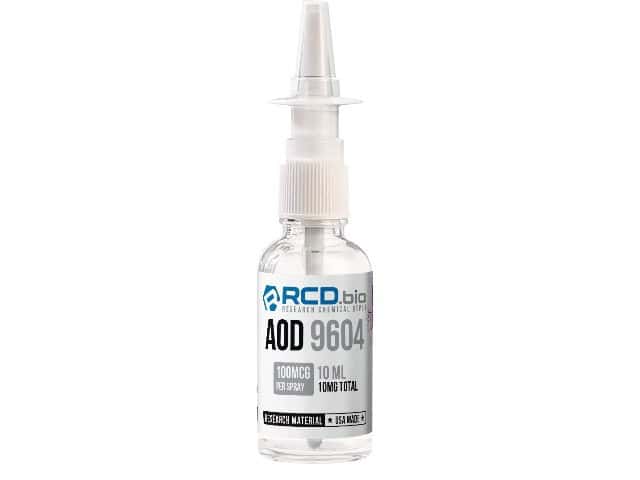
AOD 9604 Nasal Spray by Research Chemical Depot
Shop Now →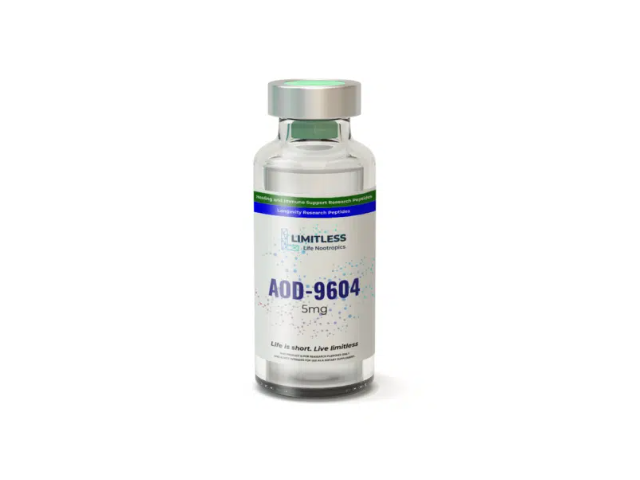
AOD-9604 Peptide by Limitless Life Nootropics
Shop Now →Disclosure: These are affiliate links. I earn a small commission if you purchase — at no extra cost to you. I only recommend products I personally use or have thoroughly researched.
Research & Studies
This section includes 8 peer-reviewed studies referenced in our analysis.