
- Neuroprotection against oxidative stress and ischemia
- Anxiety reduction without sedation or dependence
- Cognitive support during brain recovery
- Mitochondrial energy production support
- Membrane stabilization and free radical scavenging
I’ll be honest — I almost dismissed emoxypine the first time I came across it. Another obscure Russian compound with a name that sounds like a cleaning product? Hard pass.
Then I actually read the research. And then I read more. And then I tried it.
Turns out, the Soviets weren’t just building rockets and chess grandmasters. They were quietly developing some of the most interesting neuroprotective compounds in pharmacology — and emoxypine might be one of their best-kept secrets. It’s been prescribed to millions of patients in Russia for decades, backed by multiple randomized controlled trials, and it has a safety profile that makes most anxiolytics look reckless by comparison.
The catch? Almost nobody in the West has heard of it.
The Short Version: Emoxypine (sold as Mexidol in Russia) is a synthetic antioxidant structurally related to vitamin B6 that protects brain cells from oxidative damage, supports mitochondrial energy production, and provides mild anxiety relief — all without the dependence risk of benzodiazepines. It’s best suited for people dealing with brain fog from oxidative stress, mild anxiety, or those wanting a well-tolerated neuroprotective agent. The evidence is strongest for brain recovery and chronic cerebrovascular conditions, while its effects in healthy people seeking a cognitive edge remain largely unproven.
What Is Emoxypine?
Emoxypine (2-ethyl-6-methyl-3-hydroxypyridine) is a synthetic compound that shares its basic structure with pyridoxine — vitamin B6. But don’t let that fool you into thinking it’s just another B vitamin. The modifications Soviet chemists made in the 1970s gave it entirely different pharmacological properties.
The compound was first synthesized by L.D. Smirnov and K.M. Dumayev as part of a broader Soviet research program hunting for synthetic antioxidants — agents that could protect soldiers, cosmonauts, and athletes from the damaging effects of extreme stress, low oxygen, and physical exhaustion. In the early 1980s, they created the succinate salt form (emoxypine succinate), which became the basis for the pharmaceutical product Mexidol.
And Mexidol isn’t some fringe supplement. It earned the Prize of the Government of the Russian Federation in 2003 for its role in treating cerebrovascular diseases. It’s been prescribed in Russian hospitals for stroke recovery, chronic brain ischemia, anxiety disorders, and even alcohol withdrawal for over two decades. That said, it has no FDA or EMA approval, and you won’t find it at your local pharmacy in the West.
The most common form you’ll encounter is emoxypine succinate — and that “succinate” part matters. The succinic acid component isn’t just a salt to improve absorption. It feeds directly into your mitochondria’s energy production chain, which gives the compound a dual mechanism that the free base form doesn’t offer.
How Does Emoxypine Work?
Think of your brain cells as houses in a neighborhood. Oxidative stress is like a slow-burning fire spreading from house to house — damaging the walls (cell membranes), shorting out the wiring (mitochondria), and disrupting communication between neighbors (neurotransmitter signaling). Emoxypine works like a combination fireproofing agent and repair crew.
Here’s what’s happening at the molecular level:
Antioxidant defense. Emoxypine directly scavenges free radicals and inhibits lipid peroxidation — the chain reaction that damages cell membranes. It also boosts your body’s own antioxidant system by enhancing superoxide dismutase (SOD) activity. On top of that, it has iron-chelating properties, which is particularly interesting for neurodegenerative conditions where excess iron accelerates brain cell damage.
Membrane stabilization. This is the “membranotropic” effect that Russian researchers emphasize. Emoxypine physically stabilizes cell membranes, preserving their fluidity and structure when they’re under oxidative attack. Healthy membranes mean receptors work properly, ion channels function normally, and cells communicate more efficiently.
Mitochondrial protection. The succinate component feeds directly into Complex II of the electron transport chain — essentially giving your mitochondria extra fuel to keep producing ATP (cellular energy) even when oxygen is scarce. This is why Russian clinicians use it for ischemic conditions, where blood flow to the brain is compromised.
Neurotransmitter modulation. Emoxypine inhibits ion currents through the NMDA receptor complex, which likely explains its anxiolytic and neuroprotective effects. It also increases dopamine content in the brain, potentially contributing to mood and motivation. Unlike phenibut, which hammers the GABA system and carries real dependence risk, emoxypine’s neurotransmitter effects are subtle and balanced.
In plain English: it protects your brain cells from damage, keeps their walls intact, fuels their power plants, and gently adjusts the chemical messaging system — all without the sledgehammer approach of most psychoactive compounds.
The Evidence Behind Emoxypine
Here’s where I need to be straight with you. The research on emoxypine is genuinely impressive in scope — but it comes with a major asterisk.
What the Research Actually Shows
Stroke recovery has the strongest evidence. The MIR trial (2025) — an international, multicenter, randomized, double-blind, placebo-controlled study with 304 patients — found that Mexidol produced statistically significant improvements in disability, neurological deficit, and mobility compared to placebo. The safety profile was identical to placebo. A meta-analysis of 11 studies (2023) confirmed these findings, showing significant improvements in neurological scores at multiple time points.
Chronic brain ischemia and cognitive impairment is supported by the MEMO trial — a double-blind, placebo-controlled study of 318 patients that found 75 days of Mexidol therapy significantly improved cognition (MoCA scores), quality of life, fatigue, and anxiety compared to placebo across age groups from 40 to 90 years.
ADHD in children got a boost from the MEGA trial — a multicenter RCT with 333 children aged 6-12 showing Mexidol 125mg twice daily was significantly superior to placebo on both inattention and hyperactivity measures (p=0.000024). That’s a striking result.
Anxiety and mood improvements show up consistently across rehabilitation studies, with one randomized study (n=60) finding significant reductions in both anxiety and depression scores in stroke and traumatic brain injury patients, with zero adverse events.
Alcohol withdrawal benefits are supported by a double-blind, placebo-controlled RCT showing emoxypine accelerated the reduction of anxiety symptoms by 25-50% during withdrawal treatment.
Reality Check: Nearly all of this research originates from Russia and CIS countries, often published in Russian-language journals, and the manufacturer (Pharmasoft) has ties to much of the research. No systematic reviews or meta-analyses from Western institutions exist. The trial designs are solid — randomized, double-blind, placebo-controlled — but the lack of independent Western replication means we should hold the results with cautious optimism rather than full conviction. There are also zero clinical trials testing emoxypine in healthy people looking for cognitive enhancement.
How to Take Emoxypine Without Wasting Your Money
Dosage: The standard oral dose is 125-250mg taken one to three times daily, with a maximum of 750mg per day. Start at the lower end — 125mg once or twice daily — and work your way up over a week or two.
Timing: Take it with food to enhance absorption. Because the half-life is short (2.0-2.6 hours), splitting your dose across the day makes more sense than taking it all at once. Some users report drowsiness at higher morning doses, so you might front-load your dosing later in the day if that happens.
Forms: Go with emoxypine succinate over the free base. The succinate form is what’s been used in virtually all the clinical research, and the succinate moiety itself contributes to the mitochondrial benefits. It’s available as 125mg capsules from Western nootropic vendors or as the branded Mexidol tablets (125mg and 250mg FORTE) imported from Russia.
Duration: Russian prescribing guidelines recommend treatment courses of 2-8 weeks, with gradual tapering over 2-3 days rather than abrupt discontinuation. This isn’t because of withdrawal risk — it’s standard pharmacological practice for any compound affecting brain chemistry.
Insider Tip: Don’t expect to feel this one right away. Most users report needing 1-2 weeks of consistent daily use before noticing benefits. The effects are more “background improvements” — less brain fog, calmer under stress, slightly sharper — than the in-your-face rush of a stimulant. If you’re chasing an immediate buzz, this isn’t your compound.
Starting protocol:
- Week 1: 125mg with breakfast
- Week 2: 125mg with breakfast and lunch
- Week 3-6: Adjust to 125-250mg, 2-3 times daily based on response
- Reassess at 6-8 weeks
The Side Effects You Should Know About
This is where emoxypine genuinely shines compared to most compounds in its class.
Official prescribing data lists side effects as “very rare” (occurring in less than 0.01% of patients):
- Drowsiness (the most commonly reported by nootropic users)
- Nausea
- Dry mouth
- Mild GI discomfort — heartburn, flatulence, diarrhea
- Headache
In the large clinical trials (MIR, MEMO, MEGA), adverse event rates in the Mexidol groups were statistically indistinguishable from placebo. That’s remarkable for a compound with genuine pharmacological activity.
Who should avoid emoxypine:
- Anyone with acute liver or kidney dysfunction
- Pregnant or nursing women (no safety data exists)
- Children under 6
- People with lactose intolerance (tablet formulations contain lactose — capsule forms may not)
Important: Emoxypine enhances the effects of benzodiazepines, antidepressants, and other CNS-active drugs. If you’re taking any of these, start with the lowest dose and monitor carefully. The potentiation effect isn’t necessarily dangerous, but it can amplify sedation and other effects beyond what you’d expect.
The big differentiator: Unlike benzodiazepines, phenibut, or even some racetams, emoxypine shows no evidence of tolerance, dependence, or withdrawal in any of the clinical literature. For an anxiolytic compound, that’s a genuinely rare quality.
Stacking Emoxypine
Emoxypine’s mechanism — antioxidant protection, membrane stabilization, mitochondrial support — makes it a natural complement to compounds that work through different pathways.
Well-supported combinations:
-
Emoxypine + Vinpocetine: This pairing has actual clinical data behind it. Emoxypine provides antioxidant and membrane protection while vinpocetine enhances cerebral blood flow — two complementary approaches to brain health that a 2017 study confirmed work well together for cerebrovascular conditions.
-
Emoxypine + Racetams (Piracetam, Aniracetam): Emoxypine’s neuroprotective action creates a healthier cellular environment for racetams’ cognitive enhancement effects to work in. Different mechanisms, potentially additive benefits.
-
Emoxypine + Alpha-GPC or Citicoline: Choline sources support acetylcholine production while emoxypine protects the neurons using it. A solid foundation stack for general brain support.
Combinations to approach with caution:
-
Benzodiazepines or Phenibut: Emoxypine potentiates GABAergic compounds. This means the sedative and anxiolytic effects stack — which could be too much. If you’re using any GABAergic substance, reduce the dose of one or both.
-
Antidepressants: Same potentiation concern. Not necessarily dangerous, but worth monitoring, especially when starting the combination.
Pro Tip: If you’re stacking emoxypine for neuroprotection, pair it with compounds that target different mechanisms. Emoxypine handles the oxidative stress angle exceptionally well — let your other compounds cover cholinergic support, blood flow, or neurotransmitter modulation.
My Take
I’ll cut straight to it: emoxypine is one of the more interesting compounds in my supplement rotation, but probably not for the reasons most people pick up nootropics.
I don’t take emoxypine expecting to suddenly crank out twice the work or remember where I left my keys. That’s not what it does. What I notice — and it took about two weeks of consistent use to notice — is a subtle reduction in the background noise. Less mental static. A calmer baseline when stress kicks up. The kind of effect that’s easy to miss if you’re looking for fireworks, but hard to ignore once you recognize it.
Here’s who I think should consider emoxypine:
Best for: People dealing with brain fog they suspect is related to oxidative stress or inflammation. Anyone wanting a well-tolerated anxiolytic without the dependence trap of benzos or phenibut. People in their 40s and beyond who want a neuroprotective “insurance policy” with solid safety data. Anyone recovering from neurological insult who wants an evidence-backed adjunct.
Probably not for you if: You’re a healthy 25-year-old looking for a competitive edge on exams — the evidence for cognitive enhancement in healthy brains simply doesn’t exist yet. You want something you’ll feel working within an hour. You’re looking for a primary anxiolytic for clinical-level anxiety — talk to a doctor first.
The thing that keeps emoxypine in my rotation is the risk-reward calculus. The downside risk is genuinely minimal — decades of clinical use, large RCTs showing a safety profile identical to placebo, no dependence or withdrawal. The upside is real neuroprotection and mild anxiolytic benefits backed by harder evidence than most compounds in the nootropic space.
Is it the most exciting nootropic? No. Is it one of the most sensible? I’d argue yes. Sometimes the smartest move isn’t the flashiest one — it’s the one that quietly protects what you’ve already got.
Recommended Emoxypine Products
I know how frustrating it is to sort through dozens of brands making the same claims. These are the ones I've personally vetted — because quality is the difference between results and wasted money.
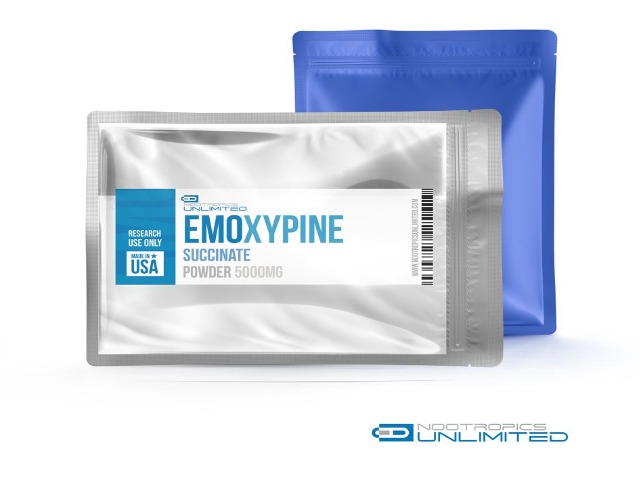
Emoxypine Succinate Powder // 5g by Nootropics Unlimited
Shop Now →Nootropics Depot Buy Emoxypine Capsules 125mg
Shop Now →Disclosure: These are affiliate links. I earn a small commission if you purchase — at no extra cost to you. I only recommend products I personally use or have thoroughly researched.
Research & Studies
This section includes 5 peer-reviewed studies referenced in our analysis.