I first stumbled onto the method of loci during a particularly brutal semester of organic chemistry. I was drowning in reaction mechanisms, molecular structures, and enzyme pathways — the kind of information that doesn’t stick no matter how many times you re-read your notes. A friend who competed in memory championships casually mentioned he could memorize a shuffled deck of cards in under two minutes using something called a “memory palace.” I was skeptical. Then he taught me the basics, and within a week I was memorizing entire lecture outlines in a single pass.
That experience fundamentally changed how I think about memory. Most of us assume memory capacity is fixed — you either have a good memory or you don’t. The research tells a very different story. Memory is a skill, and the method of loci is arguably the most powerful training tool ever developed for it. Memory champions don’t have structurally different brains. They’ve simply learned to encode information in ways that leverage how human memory actually works — spatially and visually.
Whether you’re a student tackling complex material, a professional who needs to retain vast amounts of information, or someone concerned about age-related cognitive decline, this technique can genuinely transform your ability to remember. And when you combine it with the right nootropics for memory, the results can be remarkable.
The Short Version: The method of loci (memory palace) works by converting abstract information into vivid spatial imagery placed along a familiar route. Research shows it’s the most effective mnemonic technique for sequential recall and even works in people with depression-related memory impairment. Pair it with memory-supporting nootropics like Bacopa monnieri, Lion’s Mane, and citicoline for the best results.
What Is the Method of Loci?

The method of loci — also called the memory palace technique or journey method — is a mnemonic strategy developed by the ancient Greek poet Simonides of Ceos around 500 BC. The word “loci” is Latin for “places,” and the technique works by anchoring information to specific locations along a familiar mental route.
Here’s why it works so well: your brain evolved to remember spatial environments. Our ancestors needed to remember where food sources were, which paths led to danger, and how to navigate back to shelter. That spatial memory system is incredibly robust — far more reliable than the verbal or abstract memory systems we typically rely on for studying. The method of loci essentially hijacks this ancient navigation hardware and repurposes it for memorizing anything you want.
Research consistently validates this approach. A 2025 systematic review and meta-analysis published in the British Journal of Psychology confirmed that the method of loci produces a large effect on immediate serial recall compared with rehearsal (Cohen’s d = 0.88, 95% CI [0.47, 1.25]) — a robust effect size that establishes it as the most scientifically validated mnemonic technique available. Neuroimaging studies using fMRI reveal that method of loci training engages the hippocampus, parahippocampus, and retrosplenial cortex — the brain’s spatial navigation network — and generates unique neural representations that predict individual memory performance. Brain imaging of memory athletes reveals that their superior performance isn’t due to structural brain differences but rather to distributed connectivity changes driven by consistent mnemonic practice. In other words, anyone can develop this skill.
What sets the method of loci apart from other mnemonic techniques like the Leitner system or simple acronyms is its ability to preserve sequential order. Because you’re mentally walking a route, the information naturally comes back in the correct sequence — making it ideal for speeches, lists, procedures, and structured academic material.
Perhaps most impressively, research shows the method of loci is the only mnemonic technique that significantly improves memory recall in people with depression, a condition that normally devastates the ability to retain and retrieve information.
How To Build a Memory Palace
Building your first memory palace is straightforward. The key is starting with a location you know extremely well.
Step 1: Choose Your Route
Pick a familiar place — your childhood home, your daily commute, your current apartment. The location needs to be somewhere you can mentally walk through with your eyes closed and recall specific details. Your route through this space should follow a natural, consistent path.
For your first memory palace, I recommend your home. Start at the front door and map out a logical path through the rooms: front door, entryway, living room, kitchen, bathroom, bedroom, and so on.
Step 2: Identify Distinct Locations (Loci)
Along your route, identify 10-20 specific, distinct spots. These are your “loci” — the shelves where you’ll place information. Be precise:
- The doormat at your front entrance
- The coat hook on the wall
- The coffee table in the living room
- The kitchen sink
- The refrigerator door
Each locus should be visually distinct and spaced far enough apart mentally that they don’t blur together.
Step 3: Encode Information as Vivid Images
This is where the magic happens. Take whatever you need to memorize and convert each item into the most vivid, bizarre, exaggerated mental image you can create. Then place each image at the corresponding locus along your route.
The rule of thumb: the weirder, the better. Your brain preferentially remembers things that are unusual, emotional, or sensory-rich. A mundane image fades quickly. An absurd one sticks.
Example: Suppose you need to memorize a grocery list. If the first item is “eggs” and your first locus is the front door, don’t just imagine eggs sitting on the doorstep. Imagine cracking your front door open and a tidal wave of scrambled eggs floods out, steaming hot, with the smell of butter filling the air. That image will stick.
Step 4: Walk the Route to Recall
When you need to retrieve the information, simply take a mental walk through your palace. Visit each locus in order, and the associated images — and therefore the information — will come flooding back. The spatial scaffolding provides the retrieval cues your brain needs.
With practice, you can build multiple memory palaces for different topics and maintain them simultaneously. Competitive memorizers often have dozens of palaces, each dedicated to different types of information.
Practical Applications
The method of loci isn’t just a party trick for memorizing playing cards. It has serious practical applications:
- Medical students use it to memorize anatomy, pharmacology, and diagnostic criteria
- Law students use it for case law and statutory elements
- Public speakers use it to deliver entire presentations without notes
- Language learners use it to rapidly acquire new vocabulary
- Professionals use it for client names, product specs, and meeting agendas
If you’re a student looking for a complete cognitive optimization approach, check out my guide on the best nootropics for studying, memory, and focus.
Does Memory Training Improve Overall Cognition?
Here’s an honest nuance. Research shows that memory training with techniques like the method of loci produces significant improvements in memory tasks, but the evidence for transfer to general cognitive ability is mixed. A meta-analysis found that six weeks of memory training can improve memory performance — especially in older adults — and may modestly improve fluid intelligence, but doesn’t appear to broadly alter cognitive status or non-verbal reasoning.
A recent smartphone-based study that deployed method of loci training across adults aged 20-90 found encouraging results: young and younger-old adults (55-69) showed consistent improvements correlating with training volume, while adults 70+ required more practice (100+ trials) to reach comparable proficiency levels, but could still achieve them. Over half of participants reported improvements in everyday memory, and notably reported applying the technique to practical tasks like shopping lists. However, the study also found no transfer to face-name memory tasks — reinforcing that the benefits are task-specific rather than broadly generalizable.
In practical terms: the method of loci will make you dramatically better at memorizing things, but it won’t raise your IQ. That said, the discipline of regular mental practice, combined with the confidence that comes from a reliably excellent memory, can have far-reaching benefits in work and daily life.
Nootropics That Enhance Memory Training
Here’s where things get interesting for readers of this site. Combining the method of loci with targeted nootropic supplementation creates a synergy — you’re training the software (memory technique) while upgrading the hardware (neurochemistry and brain structure). Here are the compounds I recommend.
Bacopa Monnieri
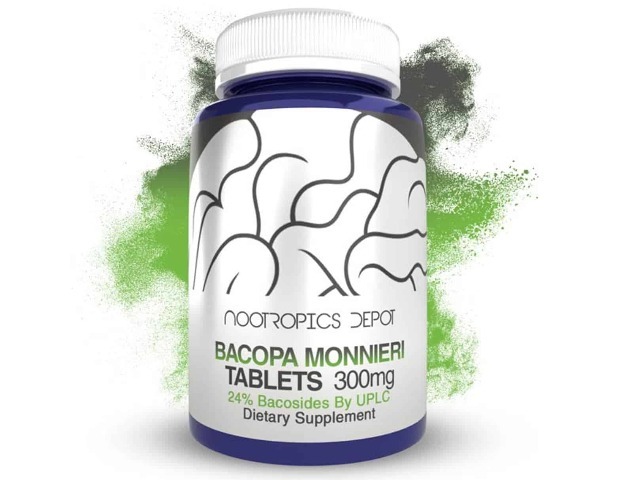
Bacopa monnieri is one of the most well-researched natural nootropics for memory. Multiple randomized controlled trials show it improves retention and acquisition of new information, particularly over 8-12 week supplementation periods. It works partly by suppressing acetylcholinesterase activity, preserving acetylcholine — the neurotransmitter most directly tied to memory encoding. A 2025 RCT of 101 adults (ages 40-70) using 300 mg/day of a standardized extract found that while objective cognitive test scores didn’t significantly differ from placebo, the Bacopa group showed significantly greater reductions in stress reactivity (p = 0.03) and reduced mental fatigue after cognitively demanding tasks — suggesting that Bacopa’s real-world memory benefits may partly stem from creating a lower-stress cognitive environment rather than direct memory enhancement alone.
For anyone actively practicing the method of loci, Bacopa is an excellent foundational supplement. It supports exactly the type of memory consolidation that makes your palace images stick over time.
- Dose: 300-600 mg of a standardized extract (45% bacosides), taken daily with a fat source
- Timeline: Effects build over 4-12 weeks of consistent use
Lion’s Mane Mushroom
Lion’s Mane (Hericium erinaceus) is unique among nootropics because it actually stimulates nerve growth factor (NGF) production and promotes hippocampal neurogenesis — the birth of new neurons in the brain’s memory center. This is directly relevant to memory palace training because the hippocampus is the exact brain region responsible for spatial memory and navigation.
A double-blind, placebo-controlled clinical trial showed Lion’s Mane improved cognitive function in adults with mild cognitive impairment. A 2025 systematic review synthesizing RCTs found a weighted mean increase of 1.17 points on the Mini-Mental State Examination in Lion’s Mane intervention groups, with all consistent directional effects pointing toward cognitive benefits. Notably, a 2025 acute dosing study found that a single 3g dose of Lion’s Mane fruiting body extract improved motor speed and dexterity (pegboard test) within 90 minutes in healthy young adults — suggesting some effects may emerge faster than previously thought, even though broader cognitive improvements still require chronic supplementation. Animal research further demonstrates enhanced spatial memory specifically — the precise type of memory the loci method relies on.
- Dose: 500-1000 mg of a hot-water or dual extract, taken daily
- Timeline: Noticeable effects typically emerge after 4-8 weeks
Citicoline
Citicoline is a choline donor and precursor to the phospholipid phosphatidylcholine, a critical component of neuronal cell membranes. Research shows it improves working memory, attention, and overall brain energy metabolism. A meta-analysis found citicoline helps restore neurotransmitter functions in patients with cognitive impairment.
What makes citicoline particularly interesting for memory palace users is its effect on working memory — the cognitive system you actively engage when constructing and navigating your mental route. Better working memory means you can build more elaborate palaces with more detail.
- Dose: 250-500 mg daily
- Stacks well with: Alpha-GPC (though don’t combine high doses of both — pick one primary choline source)
Magnesium L-Threonate
Magnesium L-threonate is the only form of magnesium shown to significantly cross the blood-brain barrier and increase brain magnesium levels. Research demonstrates it enhances synaptic plasticity and both short-term and long-term memory. Since memory palace training depends on forming and strengthening synaptic connections, ensuring adequate brain magnesium is foundational.
- Dose: 1500-2000 mg magnesium L-threonate (providing ~144 mg elemental magnesium)
- Best taken: In the evening, as it can promote relaxation
For a complete guide to magnesium forms and their cognitive benefits, see my article on magnesium for anxiety and depression.
Phosphatidylserine
Phosphatidylserine is a phospholipid concentrated in brain cell membranes that supports memory, learning, and cognitive processing speed. Research in elderly subjects showed significant improvements in memory function with supplementation. It also blunts the cortisol response to stress, which indirectly supports memory consolidation — stress hormones are among the most potent disruptors of memory formation.
- Dose: 100-300 mg daily
- Timeline: 4-8 weeks for full benefits
Putting It All Together
The method of loci is genuinely one of the most valuable cognitive skills you can develop. It costs nothing, can be practiced anywhere, and gets more powerful the more you use it. Start with a single memory palace, practice with simple lists, and gradually increase complexity as the technique becomes second nature.
If you want to accelerate the process, supporting your brain’s memory hardware with evidence-based nootropics like Bacopa monnieri, Lion’s Mane, and citicoline is a smart move. You’re not just memorizing better — you’re building a brain that’s structurally and chemically optimized for learning.
For more on memory-specific nootropics and stacking strategies, check out my complete guide to the 9 best nootropics for memory.