
- Neuroprotection against amyloid-beta toxicity
- Anti-apoptotic cellular protection
- Mitochondrial function support
- Potential longevity and healthspan effects
- Cerebral ischemia protection (preclinical)
I’ll be honest — when I first heard about a peptide produced by your own mitochondria that could protect brain cells from dying, I thought it sounded like something out of a sci-fi movie. A 24-amino-acid molecule, encoded in the same organelle that powers every cell in your body, acting as a distress signal to keep neurons alive under stress?
Then I dug into the research. Three independent labs discovered this peptide around the same time, each looking for completely different things. That kind of convergent discovery usually means you’re onto something real. But here’s the catch — and it’s a big one — there isn’t a single published human clinical trial on humanin. Not one.
So let’s talk about what we actually know, what we don’t, and whether this peptide deserves a spot on your radar.
The Short Version: Humanin is the first mitochondrial-derived peptide ever identified, discovered in 2001 during Alzheimer’s research. It shows consistent neuroprotective and anti-apoptotic effects across dozens of preclinical studies from independent labs worldwide. However, it has zero human clinical trials, a very short half-life, significant stability issues, and a serious cancer-risk concern due to its anti-apoptotic mechanism. This is a “watch closely” compound, not a “try it now” recommendation.
What Is Humanin?
Humanin is a small peptide — just 24 amino acids long — that your mitochondria naturally produce. It’s encoded by a short open reading frame hidden within the 16S ribosomal RNA gene of your mitochondrial DNA. If that sentence made your eyes glaze over, here’s the translation: your cellular power plants have a secret instruction manual, and one page of that manual codes for a tiny protein whose job is to keep cells alive when things go sideways.
The discovery story is one of my favorites in peptide research. Back in 2001, a team of Japanese researchers was screening brain tissue from an Alzheimer’s patient, looking for anything that could rescue neurons from amyloid-beta-induced death. They found humanin. Around the same time, John Reed’s lab stumbled onto it while looking for proteins that interact with Bax — a molecule that triggers programmed cell death. And Pinchas Cohen’s group found it independently while studying IGFBP-3, a growth factor binding protein. Three labs, three completely different angles, one peptide.
That convergent discovery opened an entirely new field. Humanin was the first mitochondrial-derived peptide (MDP) ever identified. Since then, researchers have found an entire family of these peptides — including MOTS-c, which has become a darling of the longevity community, and a group called SHLPs 1–6. Your mitochondria aren’t just batteries. They’re signaling hubs.
Here’s what makes humanin particularly interesting from an aging perspective: circulating levels decline as you get older. Researchers have even identified a specific genetic variant (rs2854128) associated with lower humanin levels and cognitive decline. When they supplemented humanin in mice carrying that variant, cognition improved. That’s the kind of finding that makes you sit up and pay attention.
How Does Humanin Work?
Think of humanin as a multi-channel emergency broadcast system for your cells. When things go wrong — oxidative stress, toxic protein accumulation, inflammatory damage — humanin activates multiple survival pathways simultaneously. It’s not a one-trick molecule.
On the outside of cells, humanin binds to a receptor complex made up of three proteins: gp130, CNTFR-alpha, and WSX-1. When humanin locks into this trimeric receptor, it triggers a cascade of survival signals. The JAK/STAT pathway fires up, activating genes that promote cell survival. The PI3K/AKT pathway — one of the most important pro-survival signaling routes in the body — gets switched on. And the ERK1/2 pathway, which drives cell growth and differentiation, starts humming.
Humanin also binds to a receptor called FPRL1, and this is where the Alzheimer’s connection gets interesting. Amyloid-beta — the toxic protein that accumulates in AD brains — normally binds to FPRL1 and triggers cell death. Humanin competes for that same binding site, essentially blocking amyloid-beta from pulling the trigger.
But the intracellular mechanisms might be even more important. Humanin directly grabs onto Bax, one of the key executioner proteins in apoptosis. By physically binding Bax, humanin prevents it from punching holes in the mitochondrial outer membrane — the step that commits a cell to dying. It also blocks IGFBP-3 from entering the nucleus, where it would otherwise activate death programs.
Pro Tip: If you’re comparing humanin to other neuroprotective peptides like Semax or Selank, understand that they work through fundamentally different mechanisms. Semax modulates BDNF and neurotransmitter systems. Humanin is intercepting the cell death machinery itself. They’re solving different problems.
In plain English: humanin is your mitochondria’s way of saying “don’t die yet” to stressed cells. It blocks multiple death pathways while simultaneously activating survival pathways. That’s why researchers get excited about it — and also why the cancer implications are so serious (more on that below).
Benefits of Humanin
Let me be upfront about something: every benefit I’m about to list comes from animal studies or cell experiments. I’m going to be specific about evidence quality because I think you deserve better than hype.
Neuroprotection Against Alzheimer’s Pathology
This is where the evidence is deepest. Multiple independent labs have shown that humanin — and especially its more potent analogue S14G-Humanin (HNG) — protects neurons against amyloid-beta toxicity, mutations in familial Alzheimer’s genes, and related insults. In rat models, humanin attenuates cognitive deficits and pathological brain changes induced by amyloid-beta injection. A fascinating study published in Frontiers in Aging Neuroscience showed that astrocytes release humanin to prevent synapse loss in hippocampal neurons — suggesting this is actually part of the brain’s natural defense system against neurodegeneration.
Evidence quality: Consistent across multiple labs and models. Still entirely preclinical.
Traumatic Brain Injury Protection
A 2024 study demonstrated that humanin ameliorates TBI-related cognitive impairment by reducing mitochondrial dysfunction and neuroinflammation in animal models. Given that TBI is a leading cause of cognitive disability and there are few effective treatments, this is a meaningful research direction.
Evidence quality: Preliminary. Single study paradigm.
Cerebral Ischemia and Stroke
Humanin protects against ischemia/reperfusion injury — the damage that occurs when blood flow returns to oxygen-starved brain tissue after a stroke — via the PI3K/Akt pathway in rat models.
Evidence quality: Preliminary. Limited to rodent models.
Longevity and Metabolic Health
Here’s where the observational human data gets interesting. Higher circulating humanin levels have been associated with longevity in human cohort studies. In animal models, humanin regulates lifespan and healthspan, and improves insulin sensitivity. It won’t replace exercise as a metabolic intervention, but the correlation between humanin levels and healthy aging is worth noting.
Evidence quality: Animal interventional studies + human observational data. No human trials.
Reality Check: The preclinical evidence for humanin is genuinely impressive in its consistency. But “consistent animal data” and “works in humans” are separated by a canyon that most compounds never cross. We’ve seen hundreds of neuroprotective agents succeed in mice and fail in people. Humanin may be different — its endogenous nature is a good sign — but we simply don’t know yet.
How to Take Humanin
I need to be more cautious here than with most substances I write about, because there is literally no established human dosing protocol from clinical research.
Dosage (Entirely Extrapolated)
Animal studies have used doses ranging from 0.04 mg/kg to 10 mg/kg, typically via subcutaneous or intraperitoneal injection. In anecdotal self-experimentation communities, reported doses range wildly — from 25–50 mcg/day on the conservative end to 2–10 mg/day on the aggressive end, administered subcutaneously.
Administration
Subcutaneous injection is the primary route, both in research and among self-experimenters. Humanin is a peptide, which means oral bioavailability is expected to be poor — your digestive enzymes would chew it apart. Intranasal delivery has been explored for brain delivery but isn’t well characterized.
The Half-Life Problem
This is a practical challenge that doesn’t get enough attention. Humanin’s half-life is approximately 30 minutes in mice and somewhat longer in rats. Even the more stable analogue HNG loses about 50% of its potency after 33 hours in solution at body temperature. That’s a significant pharmacokinetic limitation — the peptide is doing its job, but it doesn’t stick around long.
Storage and Handling
This matters more for humanin than most peptides. It must be stored lyophilized (freeze-dried) at -20°C or below. Once reconstituted with bacteriostatic water, keep it at 2–8°C and use it quickly. At room temperature, degradation, oxidation, and dimerization happen fast. If your vendor ships it at room temperature, that’s a red flag.
Insider Tip: If you’re seriously considering humanin, look into S14G-Humanin (HNG) instead. A single amino acid substitution — serine to glycine at position 14 — makes it roughly 1,000 times more potent than wild-type humanin. That means dramatically lower doses for equivalent effects, and potentially better cost-effectiveness. Colivelin, a humanin-derived hybrid peptide, is even more potent — active at femtomolar concentrations — though it’s harder to source.
The Side Effects Nobody Warns You About
Reported Side Effects (Mild)
From animal studies and anecdotal reports, the commonly mentioned side effects are relatively benign: injection site redness and swelling, occasional nausea (especially with initial doses), headache, dizziness, and fatigue. Nothing alarming on the surface.
The Cancer Concern (Not Mild at All)
This is the section I want you to actually read. Humanin is a potent anti-apoptotic peptide. That’s its core mechanism — it stops cells from dying. Sounds great when we’re talking about neurons under stress. It sounds terrible when we’re talking about cancer cells.
And this isn’t theoretical. A 2020 study in Scientific Reports showed that exogenous humanin promoted tumor progression in triple-negative breast cancer models — accelerating tumor growth, stimulating spontaneous lung metastases, and impairing chemotherapy effectiveness. Other research has demonstrated humanin-mediated chemoresistance in glioblastoma and anti-apoptotic effects in pituitary tumors via NF-κB activation.
Important: If you have active cancer, a history of cancer, or are undergoing chemotherapy, humanin is contraindicated. This is not a “be careful” situation — it’s a “do not use” situation. The same mechanism that protects healthy cells from death can protect malignant cells from the treatments designed to kill them.
Other Contraindications
- Pregnancy and breastfeeding — zero safety data exists
- Severe liver or kidney disease — clearance concerns with no human pharmacokinetic data
- Autoimmune disorders — humanin’s immune-modulating effects are poorly understood
- Concurrent chemotherapy — may directly reduce treatment efficacy
Drug Interactions
Largely unknown, which is itself a concern. Theoretical interactions exist with IGFBP-3-modulating therapies and any apoptosis-dependent treatment. The honest answer is: we don’t have enough data to know what interacts with what.
Stacking Humanin
Given the experimental nature of humanin, stacking recommendations are theoretical. But the logic behind certain combinations is sound.
The Mitochondrial-Derived Peptide Stack
The most intuitive pairing is with MOTS-c, humanin’s sibling from the mitochondrial genome. Where humanin focuses on anti-apoptosis and neuroprotection, MOTS-c activates AMPK and functions as a metabolic regulator and exercise mimetic. Different targets, complementary mechanisms. Some longevity-focused self-experimenters combine the two as a “mitochondrial support” protocol.
Mitochondrial Support Compounds
- CoQ10 or Ubiquinol: Supports the electron transport chain — a different layer of mitochondrial protection than humanin provides
- NAD+ precursors (NMN or NR): Some community protocols combine humanin with NAD+ precursors for broader mitochondrial health. The rationale is sound even if the evidence is anecdotal.
- PQQ: Supports mitochondrial biogenesis — making new mitochondria — while humanin protects existing ones
What to Avoid Combining
- Chemotherapy agents — humanin may directly reduce their effectiveness by blocking cancer cell apoptosis
- Other potent anti-apoptotic compounds — stacking multiple anti-apoptotic signals could compound the cancer surveillance concern
- Compounds with no interaction data — with so little known about humanin’s pharmacology, restraint is the smart play
My Take
I find humanin genuinely fascinating. The science is elegant — a tiny peptide from your mitochondrial genome that orchestrates multiple survival pathways simultaneously, discovered independently by three different research groups looking for three different things. That kind of convergent evidence means the underlying biology is real.
But here’s where I have to put my Functional Nutritional Therapy Practitioner hat on and be straight with you: I can’t recommend humanin as a practical nootropic or supplement right now. The reasons stack up fast — zero human clinical trials, a very short half-life that makes dosing logistically challenging, significant stability issues that mean you can’t trust your supply chain easily, and a cancer risk that is demonstrated in animal models, not just theoretical.
If I were ranking where to spend your money and attention for brain health and longevity, humanin wouldn’t make my top ten. Not because the science is bad — it’s actually remarkably consistent — but because the risk-benefit math doesn’t work yet for an individual consumer. Lion’s Mane, Bacopa, Creatine, and even MOTS-c all have either human data, better safety profiles, or both.
That said, if you’re deep into the longevity peptide space and already optimizing foundations — gut health, sleep, stress management, exercise — humanin is worth watching. The S14G-Humanin analogue (HNG) at 1,000x potency and Colivelin at up to 10-million-fold potency could eventually become genuinely useful therapeutics, especially for neurodegeneration. We’re just not there yet.
For now, file this one under “brilliant biology, premature application.” And if you have any history of cancer, don’t touch it — full stop.
Recommended Humanin Products
I know how frustrating it is to sort through dozens of brands making the same claims. These are the ones I've personally vetted — because quality is the difference between results and wasted money.
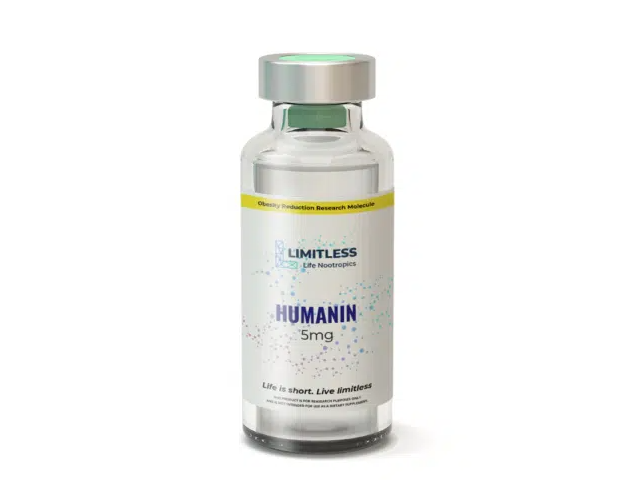
Humanin (HNG) Peptide 5mg by Limitless Life Nootropics
Shop Now →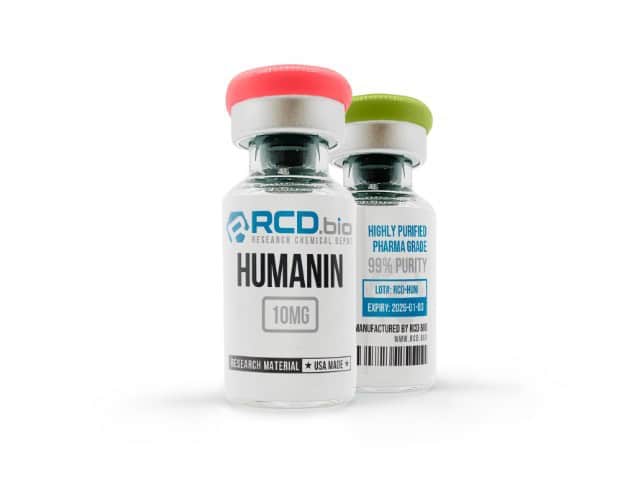
Humanin Peptide by Research Chemical Depot
Shop Now →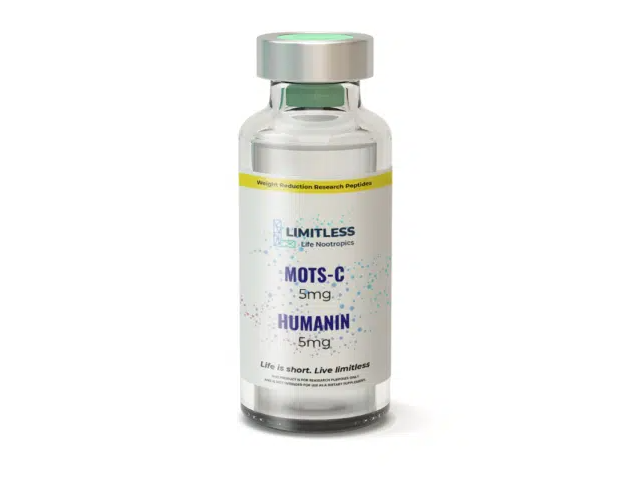
MOTS-C & Humanin Blend by Limitless Life Nootropics
Shop Now →Disclosure: These are affiliate links. I earn a small commission if you purchase — at no extra cost to you. I only recommend products I personally use or have thoroughly researched.
Research & Studies
This section includes 3 peer-reviewed studies referenced in our analysis.